The physiological sigh, or cyclic sighing, is two inhales through the nose (about 2 seconds, then 1 more) followed by one long exhale through the mouth (about 6 seconds). In a Stanford study published in 2023, five minutes a day for a month improved mood more than mindfulness meditation. With no breath-hold, it is usually very well tolerated.
You did it today without thinking. One inhale, then a second, shorter one on top of the first, and finally a long exhale that empties everything. That is a sigh. Your body triggers it on its own, several times an hour, and you only notice it when it comes at the end of a heavy day.
Physiologists call it the physiological sigh. Repeated on purpose for a few minutes, it becomes a technique in its own right, known in the research literature as cyclic sighing. It is also one of the simplest there is: no breath-hold, no complicated counting, just an exhale longer than the two inhales put together.
A reflex you already practise
On average, a person sighs every five minutes, about a dozen times an hour. It is not an emotional tic: it is a breathing reflex, driven by a small circuit of neurons in the brainstem, identified in 2016 by teams at UCLA and Stanford.
Its primary function is mechanical. The lungs contain hundreds of millions of alveoli, tiny sacs where oxygen passes into the blood. Over the course of ordinary breathing, some of them gradually collapse. A sigh, which moves roughly twice the volume of a normal breath, reopens them. It is the second inhale, the one that “tops up”, that does this work.
It also has a side everyone knows: the sigh of relief. Researchers at KU Leuven, in Belgium, have suggested seeing it as a kind of reset. When breathing becomes irregular under tension, a sigh restores a more orderly rhythm, and comes with a feeling of release.
What the Stanford study measured
In 2023, a Stanford team compared four daily five-minute practices, over one month, in around a hundred healthy volunteers: cyclic sighing, box breathing, cyclic hyperventilation followed by breath-holds, and mindfulness meditation as a point of comparison.
The authors conclude that the breathing exercises, especially exhale-focused cyclic sighing, improved mood more than meditation did, and lowered respiratory rate more. All four practices, on the other hand, reduced anxiety and negative emotions to a comparable extent.
The result should be read for what it is. Around a hundred participants, one month, people without any particular condition: it is a serious signal, published in a peer-reviewed journal, but not definitive proof, let alone a treatment. What it shows is that five daily minutes of a very simple action can have a measurable effect on mood.
Why the exhale does the work
In cyclic sighing, the two inhales last about three seconds in total, the exhale about six. The exhale is twice as long, and that is not a detail. As explained in why breathing calms the nervous system, it is during the exhale that the vagus nerve applies its brake to the heart. Lengthening that phase lengthens the moment in which the body slows down.
4-7-8 rests on the same principle, with one difference: it asks you to hold your breath for seven seconds. Some people, especially when anxiety is rising, find that hold uncomfortable. The sigh has none. Air goes in, air goes out, with no pause to hold.
How to do the physiological sigh: the protocol
Getting ready
- Sit or stand, with your shoulders relaxed.
- Breathe normally two or three times to settle in.
- Inhale through the nose (see why nasal breathing matters), exhale through the mouth.
The cycle
- Breathe in through your nose for about 2 seconds, without filling your lungs completely. Stop at around three quarters.
- Breathe in a little more, still through your nose, for about 1 second, without breathing out in between. Your lungs are now full.
- Breathe out through your mouth, slowly, for about 6 seconds, until the air runs out. Let it go, do not blow it out.
One cycle lasts nine seconds. Five minutes is a little over thirty cycles, the duration practised in the Stanford study.
When to practise it
The sigh has two uses. The first is on the spot: one or two sighs as tension rises, before opening a difficult message or on your way out of a meeting. It is a discreet action that nobody notices, and it gives you back a moment for yourself.
The second is regular: one five-minute session a day, as in the study. This is where it meets cardiac coherence: a short daily appointment rather than an emergency tool. To be honest about timelines, though: one session soothes you in the moment, while a deeper change in how you handle stress takes several weeks of practice.
Precautions
The physiological sigh is a natural action with no breath-hold, and it is generally very well tolerated. A few limits all the same:
- With asthma or COPD, filling your lungs to the maximum can be unpleasant. Keep the inhales more modest and never force.
- If you are going through an anxiety disorder, the sigh can support your daily life, but it does not replace proper care. Talk to a health professional.
The sigh in Arnasea
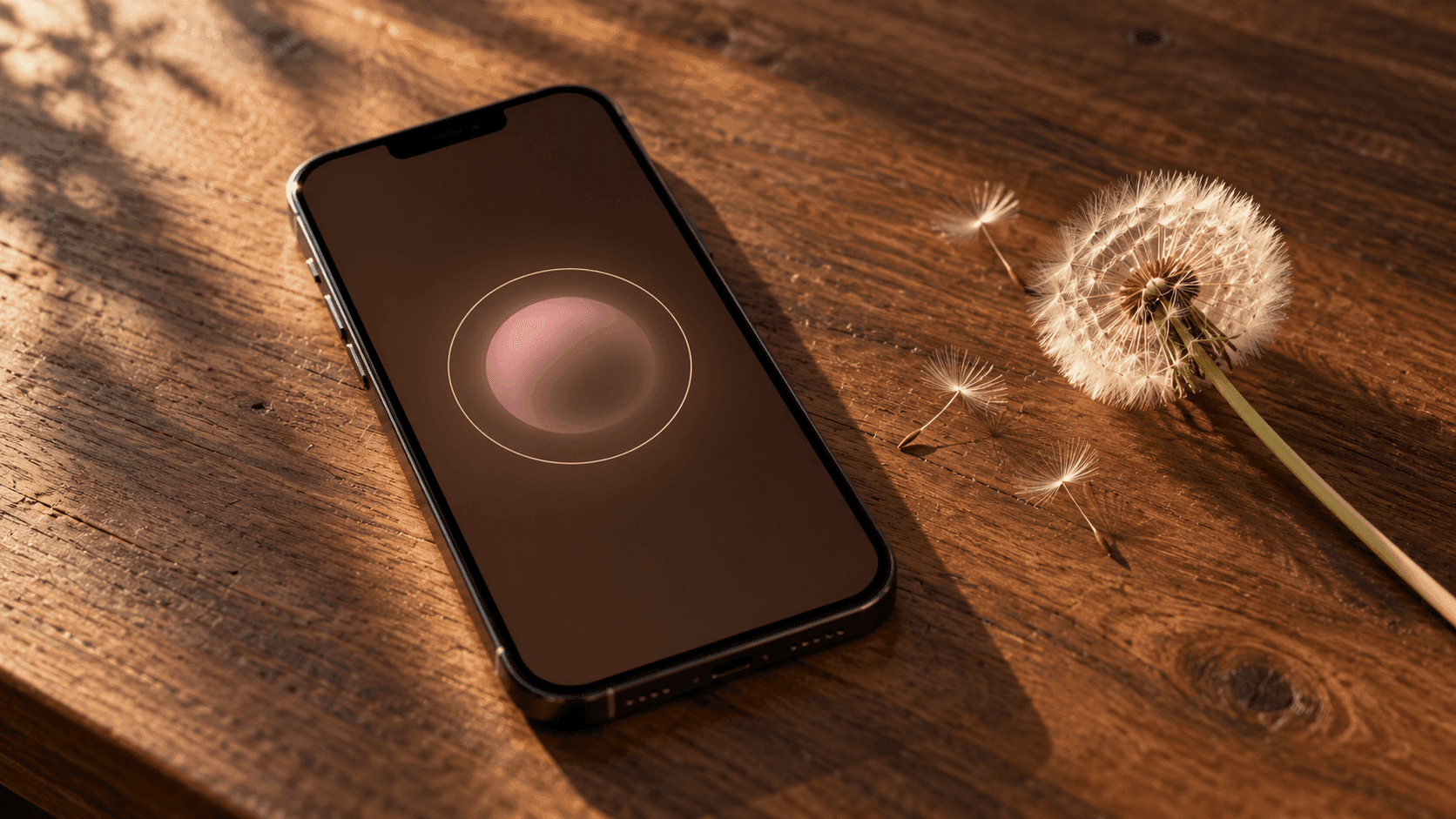
In Arnasea, the sigh is called Reset. The session lasts 4 minutes 57, that is 33 cycles of 2, 1 and 6 seconds, the dose from the Stanford study, and you can shorten or lengthen it. The sphere fills to three quarters on the first inhale, completes on the second, then empties slowly with you. There is nothing to count.
The session is free. Discover Arnasea →
Further reading
- Balban, M. Y. et al. (2023). “Brief structured respiration practices enhance mood and reduce physiological arousal”. Cell Reports Medicine, 4(1), 100895.
- Li, P. et al. (2016). “The peptidergic control circuit for sighing”. Nature, 530, 293-297.
- Vlemincx, E. et al. (2013). “Respiratory variability and sighing: A psychophysiological reset model”. Biological Psychology, 93(1), 24-32.