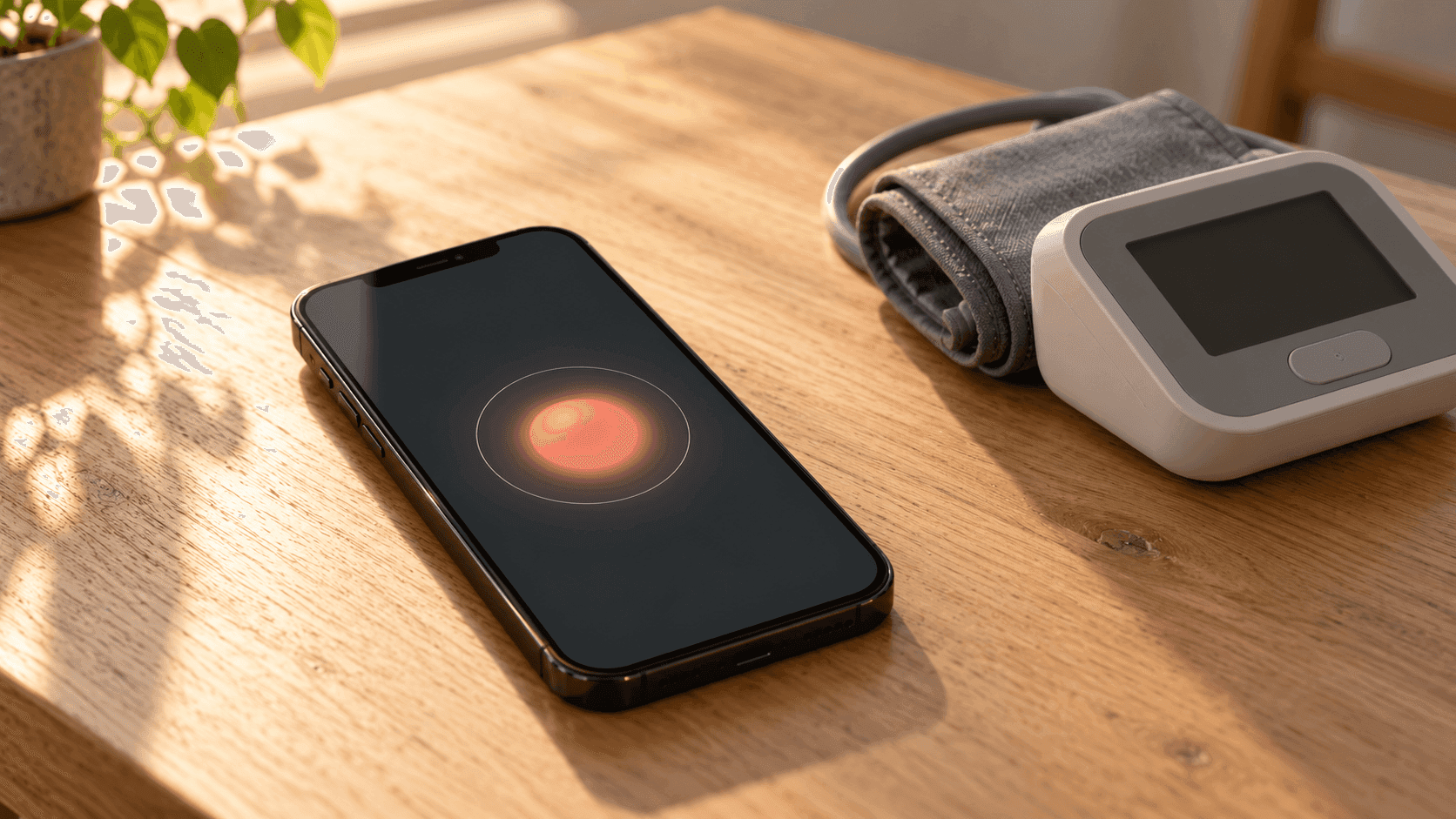
Breathing is the only vital function that is both automatic and voluntary: by slowing it down, you act on the autonomic nervous system. The heart slows with each exhale under the action of the vagus nerve, which is why an exhale longer than the inhale helps. At around six breaths per minute, heart rate variability rises sharply.
Try slowing your heart rate by decision alone. Try lowering your blood pressure, speeding up your digestion, dilating your pupils. Nothing happens. These functions run without you, steered by the autonomic nervous system, and they are beyond the reach of willpower.
Breathing belongs to the same system. It runs on its own, including while you sleep, and you have never had to think about it. Except that this one, you can take control of at any moment. It is the only vital function that is both automatic and voluntary, and that is the whole story.
A way into a closed system
The autonomic nervous system has two modes. The sympathetic side prepares for action: heart speeding up, muscles fed, attention narrowed. The parasympathetic side handles rest, digestion and recovery. At every moment, one takes over from the other depending on what your body believes the situation to be.
The key word is believes. This system does not read your calendar, it reads bodily signals. And breathing happens to be one of the signals it watches most closely. By changing your breathing on purpose, you are not imitating calm: you are literally sending the signals a calm body produces, and the system responds accordingly.
Why the exhale matters more than the inhale
Your heart rate is not regular. It speeds up slightly when you breathe in and slows down when you breathe out. The phenomenon has a name, respiratory sinus arrhythmia, and it is perfectly normal: it is the vagus nerve, the main pathway of the parasympathetic system, releasing and then reapplying its brake on the heart with every cycle.
The consequence is direct. An exhale longer than the inhale lengthens the phase in which that brake is applied. You do not “think” your heart slower, you create the mechanical conditions for it to slow. This principle shapes the most effective techniques: 4-7-8, with its exhale twice as long as the inhale, is nothing more than a systematic use of this mechanism. Your body even has a reflex version of it: the physiological sigh, two inhales followed by a long exhale, which it triggers on its own several times an hour.
The corollary works the other way too: fast, shallow breathing, the kind that settles in unnoticed in front of a screen or during a tense conversation, actively sustains the state of alert. Your breath does not just reflect your state, it maintains it.
Six breaths a minute
There is a pace around which the effects become clearly measurable: about six cycles a minute, five seconds in and five seconds out. At this rate, the oscillations of the heart rate fall into phase with those of blood pressure, and heart rate variability rises sharply.
That variability is a good indicator of how flexible the nervous system is: the higher it is, the better the body absorbs strain and recovers. This is the territory of cardiac coherence, which is really just a way of holding this rhythm long enough for the effect to settle in.
A tool at hand, not a remedy
The practical value of all this is anything but theoretical. Unlike almost everything that acts on your inner state, your breath needs no equipment, no place, no preparation, and no explaining to anyone what you are doing. It is available in a queue, before you speak in public, at three in the morning when sleep will not come back.
We should be clear about its scope, though. Slow breathing cures nothing, replaces no treatment and does not make the causes of stress go away. What it does, and that is already considerable, is give you a grip on your state at the very moment you thought you had none.
The difference between knowing this and getting something out of it comes down to repetition. A physiological mechanism you understand changes nothing on its own; regular practice is what shifts the threshold, over several weeks.
In Arnasea, a visual sets the pace so you never have to count or watch the clock. You close your eyes and follow. Discover Arnasea →
Further reading
- Zaccaro, A. et al. (2018). “How breath-control can change your life: a systematic review on psycho-physiological correlates of slow breathing”. Frontiers in Human Neuroscience, 12, 353.
- Lehrer, P. M. and Gevirtz, R. (2014). “Heart rate variability biofeedback: how and why does it work?”. Frontiers in Psychology, 5, 756.
- Gerritsen, R. J. S. and Band, G. P. H. (2018). “Breath of Life: The Respiratory Vagal Stimulation Model of Contemplative Activity”. Frontiers in Human Neuroscience, 12, 397.